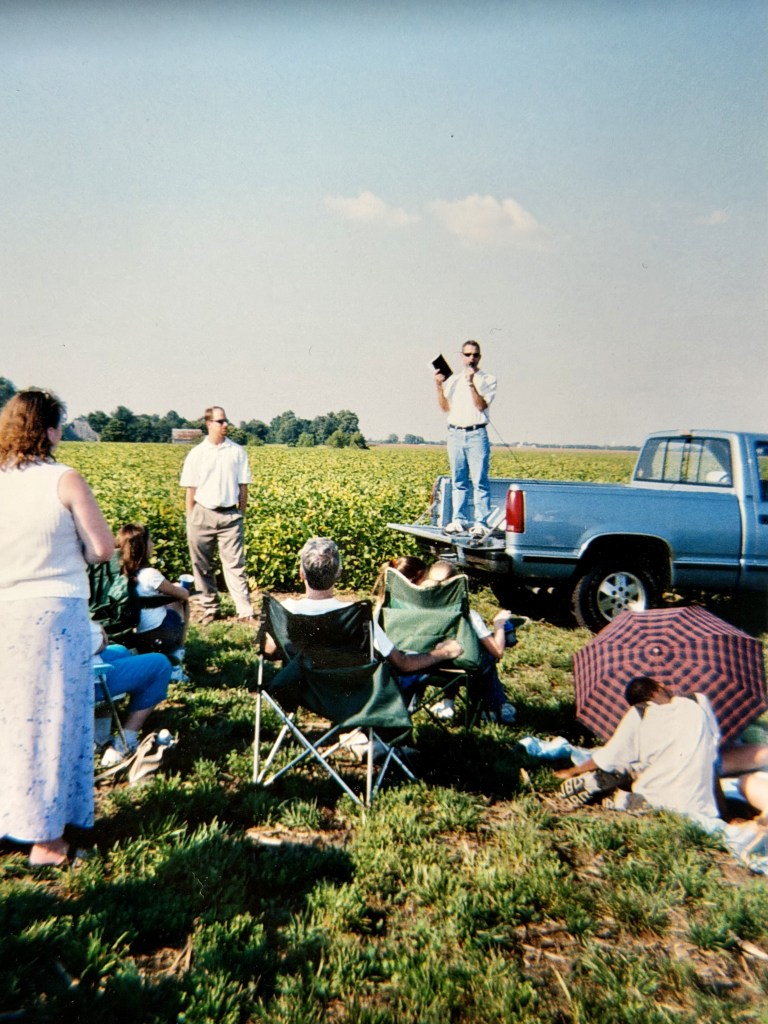
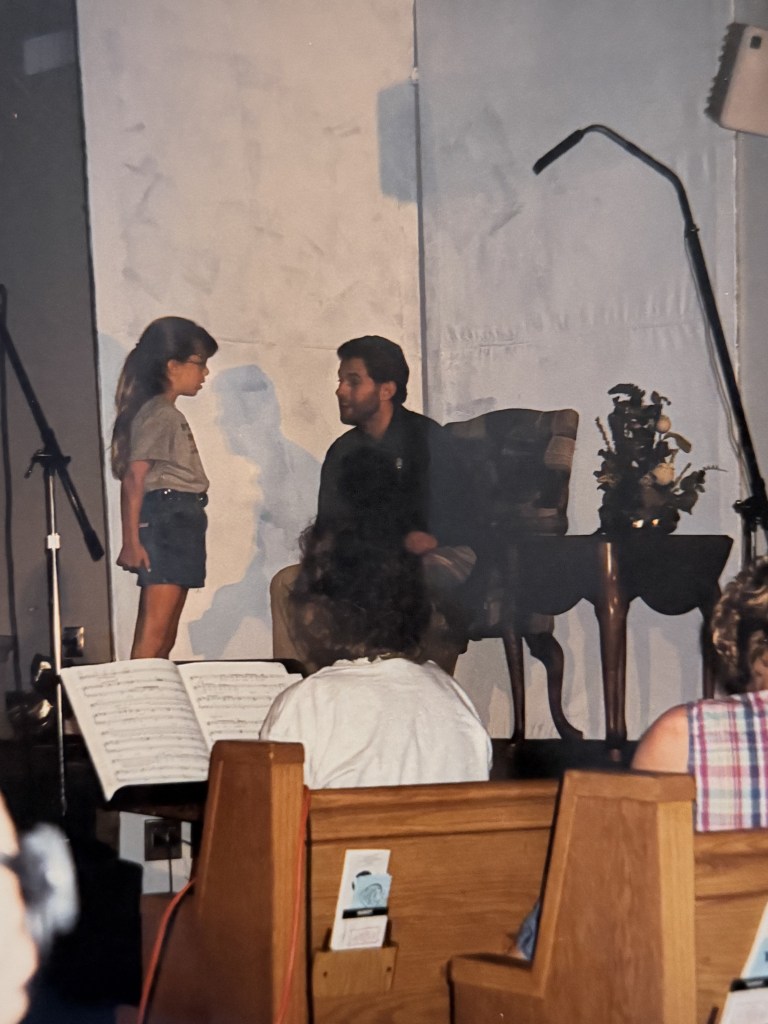
When I close my eyes and think about growing up, I picture a winding, weathered neighborhood street on the southwest side of town. I go back to the smell of the bucket seats in our used Dodge Caravan. I’m sitting around a small round table meant for four, but seated for five. My back faces detailed wallpaper with little houses and blue designs in vertical rows, and twisted tassels of the white tablecloth tickle the top of my legs. When I reflect on what gave my little life the deepest sense of security, I’m hopping up the steps of a small, green-roofed church on Outer Park Drive. It’s Sunday, and I can hear my dad’s voice spilling out from the sanctuary as the 8 o’clock service draws to a close.
I take two quick rights and one left to my Dad’s office. It’s the first door down the hallway. Behind it hangs a corkboard with various notes pinned to it. A phrase is printed and neatly displayed in the top right corner: “There’s nothing like the local church when the local church is working right.” I toss my coat on one of the two visitor chairs facing his desk and take in the quiet scene. The room’s simple decor hints at his appreciation for both lighthouses and Frank Lloyd Wright’s architectural design. His office is filled with dog-eared books and commentaries, a few Post-it notes marked with his default all-caps handwriting, and a variety of colored Pilot pens used for sermon preparation.
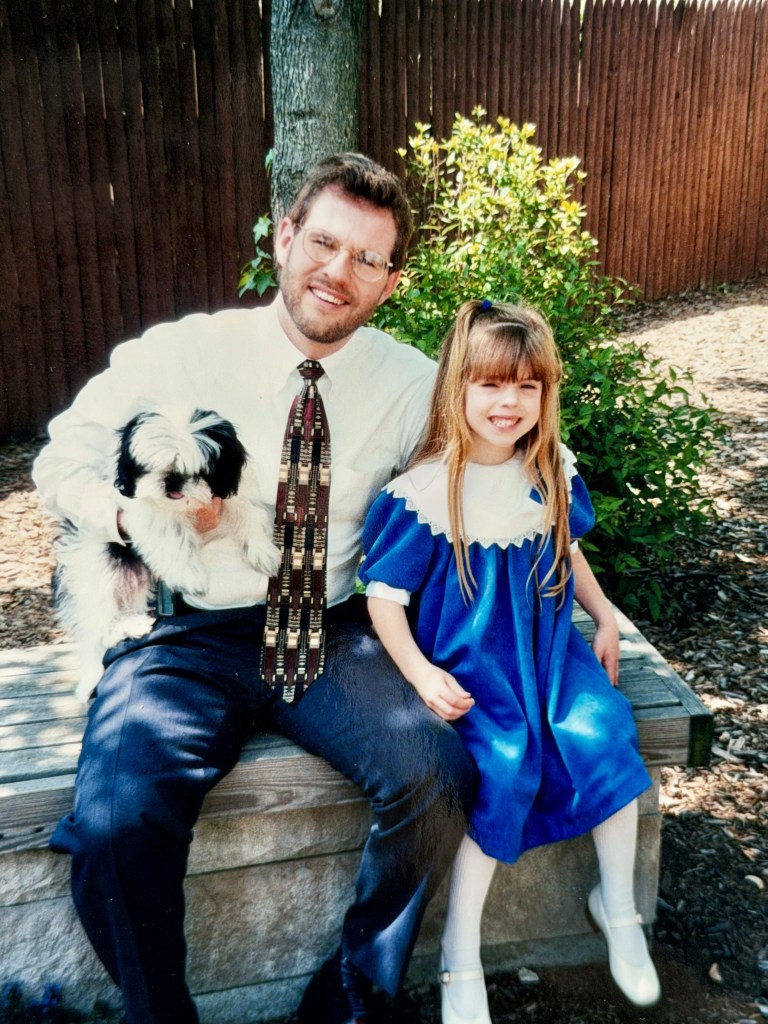
Growing up as Pastor Jeff’s only daughter carried a certain weight, as every P.K. (Pastor’s Kid) eventually discovers. But for me, it shaped my sense of belonging. I knew every square inch of that church building, and everyone in those days knew me. My life orbited around Sundays and Wednesdays, church potlucks held in the basement, and Monday night small group at our house. Being the pastor’s daughter outlined my identity, deepened my faith, and influenced my habits.
When I was twelve, I became the only child at home overnight when my oldest brother left for college and my middle brother left for residential high school over three hours away. It was 2005, and my dad was leading the growing church through a transition that would require purchasing land to build a new campus. The giving campaign for our new site was called YES! Lord, and our family was one of many in the church sacrificially giving above and beyond normal tithes and offerings. We cut cable television and simplified meals, wore hand-me-down clothing, and trusted God would provide a ram in the thicket for our every need.
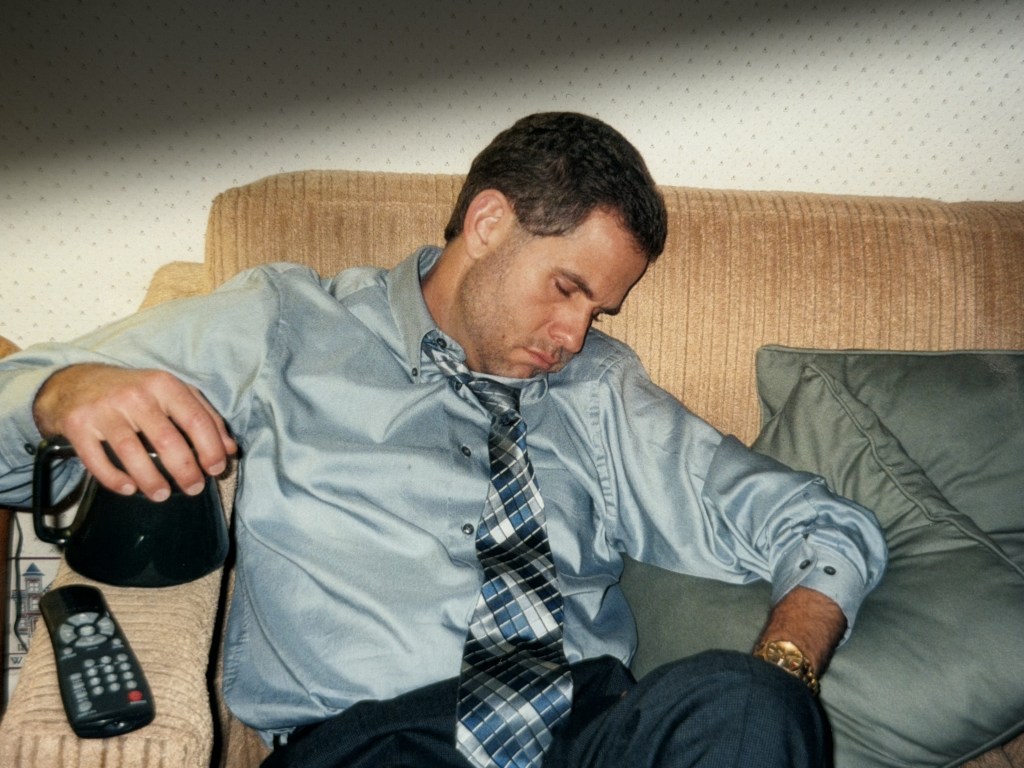
The church would eventually relocate to a new building on Woodside Road the following year. Dad worked intense hours and carried the quiet pressures of leadership. Mom and I often came across him fallen asleep sitting up on the couch. What was funny as a middle schooler is now a sign to me of how a man gave his life to loving the church.
I found it hard to adjust from being the youngest child to the only child at home. The house felt quieter, and I was lonely. So I took to sleeping in my brother’s bottom bunk down the hall to try to feel like I wasn’t. But Dad paid attention to my middle school struggles. For the next six years, he ensured we always had Monday night dates together, just the two of us. We’d use gift cards at Panera and get gas and groceries afterward at Sam’s, like clockwork. When I got older, we’d go walking, often talking about books we loved, leadership, and the church.
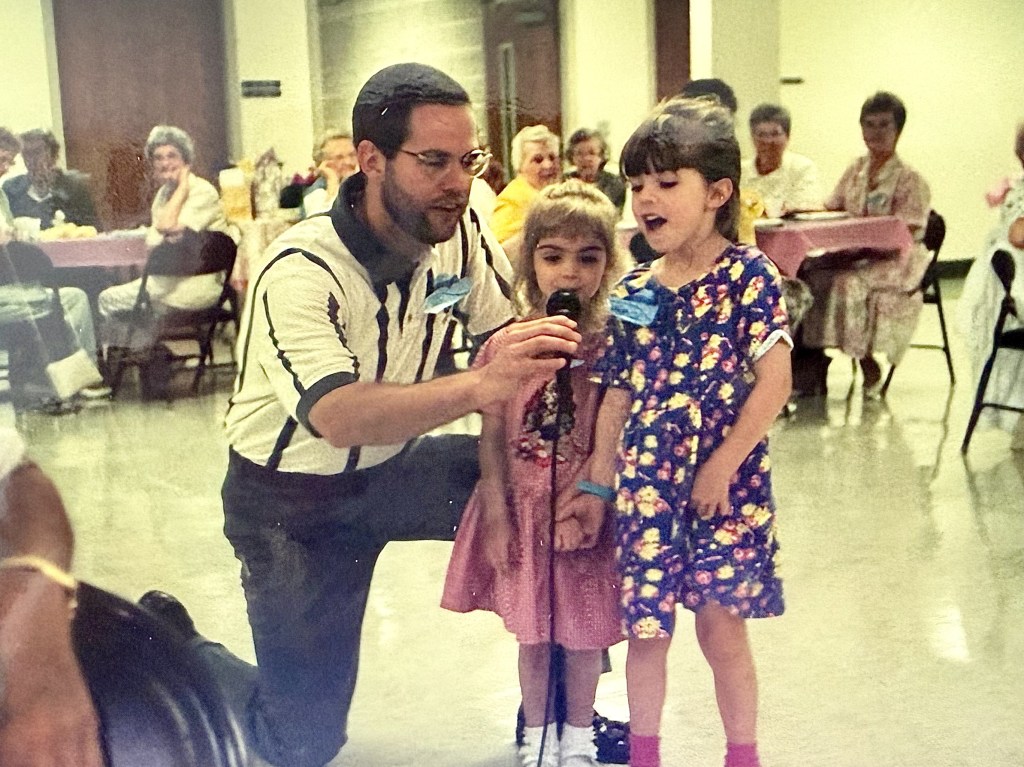
Sometimes I felt like his shadow, running errands with him while he took calls in the car. I’d sit on the floor of his office while he wrapped up final tasks. I knew sometime after the dinner hour on Saturday nights, he’d retreat to the back room to study his notes. When he had long days, I learned when to knock and when I could get away with quietly listening with my ear to the undercut of the door. Every once in a while, I’d go calling with him to elderly church members’ homes. Sometimes we’d sing together as he played his guitar for a Sunday service. I loved it all. In all the quiet moments, I had the privilege of a lifetime.
Because I had the chance to observe what the pastor practiced.
I saw what few people saw. I treasured up little things about my dad, my pastor, that have compounded their effect on me now. Words will never be adequate enough to articulate all the ways my dad has lived out his calling as a pastor, but I want to try. Because someday, my kids will be old enough to ask why I am the way that I am. And I want to be able to point them to these words when I know I’ll be too choked up to tell my story. The story of growing up with my dad as my pastor and how, by the grace of God, I’ve picked up habits I saw him practice for decades of his life, that have transformed mine.
Others
When the church was outgrowing its building capacity, Franklin Middle School let us borrow its parking lot on Sundays. Before then, we parked on the outskirts of the church lot. Afterward, we parked on the opposite side of the school, giving us a five-minute walk from the car to the front door. Certain Sundays, I’d grumble about blisters from the church shoes Mom made me wear. Walking on the sidewalk along Outer Park back to the car, I’d ask why we had to park so far away when other families did not. Dad, with his tie catching the wind from his stride, would smile and tell me variations of, “We get to walk! When we park farther away, we make room for other people! Visitors and those with physical needs can get a closer spot. I want to always think of other people and make them feel welcome.”
He practiced the same thing when the church moved to Woodside Road. With an expansive parking lot, Dad still found the farthest spot away. With minutes added to his walk, the distance often allowed him to talk with people still lingering in the parking lot. In the winter, we’d walk against the biting wind. Too cold to hold conversation, I’d hear Dad praying under his breath that the message would make its way out of the worship center, into the parking lot, and home to people’s hearts. Parking far away gave Dad the margin to talk with God and to make people feel cared for. He never wasted a single minute.
Life came full circle for me two years ago when my husband became a youth pastor. Driving the boys to church on our first Sunday, they asked me why I was parking so far away from the building. My eyes filled when I subconsciously did what my pastor had practiced. “We get to!” was my only available response.
This past week, I learned that one of the first things my grandpa and dad did as pastors was remove the “reserved” signs for pastoral parking right next to the front door. I grew up knowing only that it’s a privilege to make room for other people.
Lift
Through years of studying the Bible, Dad developed a deep appreciation for Barnabas. The early churches in the New Testament knew Barnabas for his generosity and encouragement, and he loved the Church. He did his best to equip and coach the next generation of apostles for Christ, traveling where he was needed. Barnabas was a leader who called people up. He’s also the closest description I have for my dad.
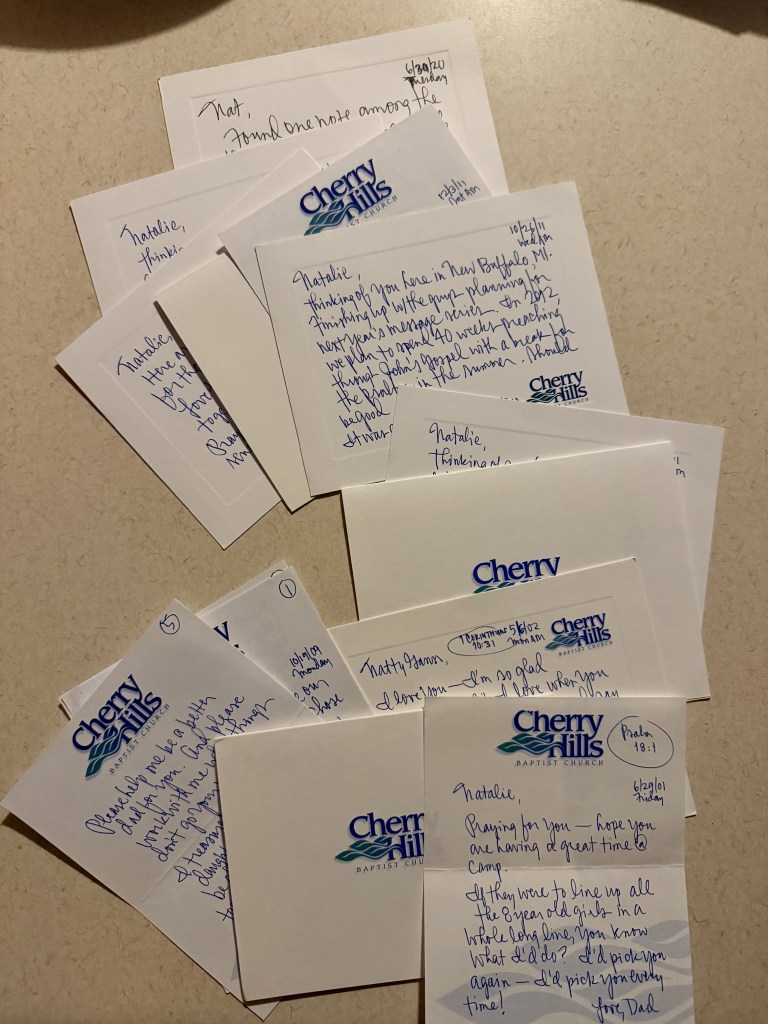
One of the ways Dad practices using his gift of encouragement is through handwritten notes. Modernity has provided him with other avenues, like texting. But most people remember finding small notes from him, often written in blue ink on church stationery, in their mailboxes.
In a box beneath my bed are dozens of notes I’ve collected from Dad–left on my pillow, mailed to my college campus, or sent to my first house. They span my lifetime. Most start in cursive with three words. Thinking of you. His words often end with a Bible verse and are signed Daddy in my younger years and graduate to Dad as I became an adult. All express gratitude of some kind. I was one of thousands on the receiving end of his notes. A few sentences to lift a person, to let them know they were on his mind, that they mattered.
What can’t be measured are the voicemails, the calls, the walks where I’ve been buoyed up once again, above the gravity of whatever obstacle I’m facing in life, by his words. He’s both the most generous person I know and the most encouraging person in my life. And he’s been a pivotal person, equipping me in my adulthood and leadership. He’s a lifter.
Catching People Doing Things Right
Pastors are typically the last to leave on Sunday and Wednesday nights. In the early years, I always thought I was let in on a cool secret when Dad would reach up high on a window ledge and grab the key that locked the doors from the inside. Sometimes we weren’t the last to leave. The custodian would just be getting out the vacuum as Dad began turning out lights in other rooms. There was one Wednesday night I’ll never forget. I stood waiting for Dad under the exit sign after the parking lot had emptied. There was the janitor, starting to clean the crumbs on the carpet. “One second,” was all Dad said.
He walked across the lobby as I lagged behind him, unsure of why I was following him. He called the man by name as he got close. With heartfelt sincerity, Dad told him, “Thank you for how you care about cleaning our building. The way you make things look so nice, even down to the bathrooms being spotless, matters. It really matters. I have credibility on stage because of how you vacuum and dust and mop.” When the gentleman tried to protest, Dad continued. “I’m serious! If our building had garbage stuck in the bushes when people walked in or grape juice stains on the carpet, it would give people something else to be concerned about besides the worship service. Thank you for clearing any of those distractions for people before they even arrive.”
As a sixteen-year-old, I went back to my job that week and cleaned like I had never cleaned before. I saw how excellence and caring about what God entrusts to us matter. As an adult employee, I subconsciously made it a practice to pick up the trash I saw in the parking lot and recognize streaks on the windows of our building. I still notice when people do ordinary small tasks well. And then I tell them. Because my dad did. And I saw how it had a 5-loaves-and-2-fish effect on the church.
Acknowledge Him
Springfield is a city of 117,000 people, but if you live here long enough, you’ll learn it’s like a small town. Some weeks, it felt like I couldn’t go anywhere with Dad without running into someone he knew. I always thought it was fascinating how he seemed to know just as many people outside of the church as he knew in it. You never knew who you’d run into with Dad pushing the grocery cart down the aisle. When that happened, we’d often stop for several minutes to talk. He’d ask about their family members by name or follow up on something they had once told him. It was entirely common for Dad to end with, “Well, do you mind if I pray?”
No one ever told him no when I was with him. So there, in the middle aisle with one hand resting on his shopping cart and the other on their shoulder, he’d briefly pray out loud over whatever they had just talked about. Prayers often started with, “Now Lord, you know what so-and-so is walking through, and we just want to stop right now and acknowledge you.” He’d ask for God to show them wisdom and what He may want that person to know. After Dad and I continued down the next aisle and out of earshot, I once asked him where he learned to stop everything and pray right there.
Dad pointed me to several things. He said that in his human weakness, he never wanted to tell someone he’d pray for them and then forget. So praying with them in the moment helped him with that and made it easier to remember them later, too. It also helped him practice Proverbs 3:5-6. Those two verses were foundational to my parents. They talked to us kids all of the time about trusting in the Lord with all our hearts and acknowledging Him in all that we did. Inviting Jesus into everyday moments is a practical way to acknowledge Jesus. It’s how we can yield our hearts to the will of God. Dad discovered that when he acknowledged the Lord as he drove, as he mowed the lawn, as he met with other people, God is faithful to guide his next step.
YES, But How?
Anyone who has listened to Dad’s messages for enough time will be familiar with several of the questions he teaches us to ask. When it comes to hearing the Scripture and wanting to be transformed by it, Dad asks, “Yes, but how?” That closing question helps people take the Word of God with them to the parking lot and know how to apply it to their everyday Christian life. When it’s hard to admit that he’s wrong, a humility question he asks is, “Lord, is it true? What do you want me to know? Lord, what do you want me to do? Who do you want me to notice?”
All of these questions are surrender questions. They’re “lean not on your own understanding” questions. Questions are vital to relationships and learning. My dad has taught people how to have meaningful conversations with God. He has shown people that life is meant to be lived in relationship with Jesus. He’s taught people to depend on Him and listen for His voice, often spoken across the ticker of our minds. Questions keep you curious. They keep you humble. And they keep you rooted in the fact that you don’t know everything, but you can know Who does. He’s our ultimate source of supply.
At the end of countless entries, my journals are filled with these same questions I have tried to practice, too. And if I’ve ever been bold enough to pray in the middle of a meeting with a co-worker, it’s because my dad prayed out loud in the middle aisle, first.
Every Seat
The older I got, the less inclined I was to play hide-and-seek or roam the church hallways while I waited for my parents to drive me home. So, Dad would invite me into what he was doing. On Saturday mornings, Dad had prayer meetings where a small team would pray for Sunday services. On occasion, I’d sit in a back row with a book, or I’d join hands.
One Saturday after they left, with the sanctuary lights dimmed, Dad knelt toward the front with his head low in prayer. Then he got up and gently placed a hand atop the backrest of the nearest seat. Then, after a moment, he paused and went to the next one. He wove in and out of rows, across aisles, down the side, and onto the next section. He murmured quietly to God as he touched each chair. This was a common practice.
Dad would pray for whoever would sit in that seat on Sunday, that the Holy Spirit would renew their hope in the Gospel. He prayed for the church to know Christ and the power of His resurrection. I would follow behind him through the rows, my hands feeling worn from gliding across the fabric of each chair. As he neared the last few rows, Dad would pray that God would fill in the gaps of his human weakness and help him communicate the Lord’s message clearly.
When Sunday arrived, as Dad closed the sermon in prayer, he said what he would often say. “Now, Lord, we ask that you come to every seat. That you make yourself real to every person sitting here. That they may know you and want to become more like Jesus.” My heart leapt in recognition. And suddenly I verifiably knew what no one else did. My dad meant every word. He had already prayed over every seat, expectant that God would do what my dad couldn’t do with thirty-five minutes and a microphone: He could transform someone’s entire life.
First Handers
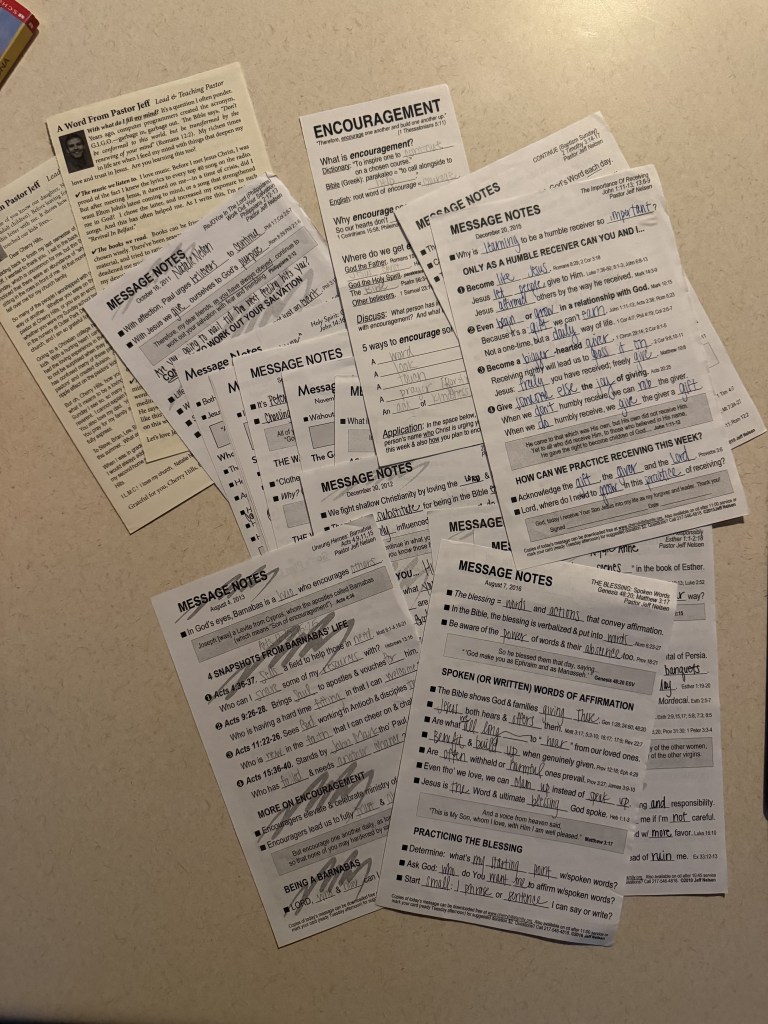
Fill-in-the-blank message notes to coincide with the sermon are infused into the DNA of Cherry Hills Church. Those of us who attended in the nineties through the mid-2010s remember what we lovingly named “squigglies”. The squigglies were the design that served as the backdrop to each of my dad’s headers on his message notes. What started on his computer as a muted yellow watermark turned gray when printed in black and white on an 8×5-inch handout. People fell into a few different camps. Some people colored in their squigglies while they listened to the message. Some people outlined their squigglies, and some left their squigglies alone. We were like sheep without a shepherd the first Sunday that Dad succumbed to modern simplicity and redacted his invitation for the congregation to doodle between fill-in-the-blanks.
It’s been over a decade since the beloved watermark was removed from message note headings, but one thing has lasted. The sound of pages turning in hundreds of Bibles. After the release of the iPhone, the App Store, and the Bible app, churches across the country felt different. People stopped bringing their Bibles. The Family Christian Bookstore closed, and the need to find a Bible case with the right number of pockets and a sturdy enough handle became a thing of the past. Dad never changed his tune. “Open your Bibles to” was always said at the top of each message. So we made sure to bring them.
As if anticipating questions in people’s minds, Dad would say some variation of this: “At Cherry Hills, we want to be first-handers with the Bible. We want to put our own fingers on the text and read for ourselves what Jesus wants to say to us today. And if you don’t have a Bible, there are black Bibles in the seat racks in front of you. If you don’t own a Bible, we would love for you to take that home with you! Don’t worry about taking one of ours–we’re happy to replace it! Now, if you’re following along in the black Bibles, you can find our text on page…”
Dad often taught that there is no substitute for being in God’s Word every day. The last message of every calendar year was dedicated to the importance of being in the Bible and the practical ways we can practice listening for God’s voice through the written word. I’m still a first-hander with the Bible because of a church that taught me the value of knowing Jesus for myself and a pastor who practiced what he preached.
Yielded
It was cold, and it was COVID, when nothing in the world felt right. My parents were visiting us at our apartment in Beloit. Unable to walk outside in the harsh Wisconsin wind, Dad and I walked up and down the underground parking garage, two floors beneath where we lived. As we paced up and down rows of cars, he reminded me that the Lord impressed upon him many years ago that he needed to begin creating a succession plan. Voluntarily allergic to change of any kind, I felt shock come over me as he shared it was nearing readiness. I was twenty-seven years old, but forever a twelve-year-old girl at heart, needing my dad to stay the same forever. I needed him to stay right where I left him after I got married. I didn’t want to imagine a version of church without his warmth. I wanted a reason to always be able to go back to Cherry Hills, to sit in the front row and find respite where my Dad led.
The plan was for Easter Sunday 2021 to be his last message as Lead Pastor, followed by a sabbatical for the rest of the year. It would give the church time to transition to new leadership before my Dad would rejoin the staff for the next five years as the Equipping Pastor. Then, at the end of 2026, Dad would retire from the church staff, take another, shorter sabbatical before returning again, this time as a church member. Because it wasn’t public knowledge at the time, I kept it entirely to myself. For months, I wrestled with Jesus about it, and I asked my dad so many questions. Why now? Why at all? What are you going to do? Is the church going to feel different? Do you feel sad? Is it okay that I’m really sad?
If you were to ask my Dad what his parents handed down to him, he could summarize it in a few words. From Grandpa Gary, he learned “surrender.” Grandpa lived his life and especially his ministry, in complete surrender to the Lord. As my brother said at his funeral, “He understood the assignment.” As my dad’s predecessor at Cherry Hills, Grandpa handed off a good baton to my dad when he was sixty-two. Unsure whether he was ready to surrender, Grandpa trusted the Lord anyway. Dad began leading Cherry Hills in 1998 and the church continued to flourish at a rapid pace. Grandpa found immense meaning in mentoring other pastors and men, preaching at other churches that were without pastors at the time, and leading a Sunday School class with Grandma for newcomers to Cherry Hills.
From Grandma Janie, Dad learned to stay yielded. She would regularly remind him, “Stay yielded, Jeff.” She knew my dad and the Nelsen tendency we have to get out ahead of Jesus. As a teenager, God gave my dad a picture of a fork in the road with a yield sign. A path with two options: one with Jesus and one without Him. Ever since, the yield sign on that road represents the need to pause and not just acknowledge Jesus in all that Dad does, but to fully lean on the Lord’s understanding. Over the span of his ministry, he has stayed yielded to God’s plan for the future of the church.
Over a decade of planning for this helped him process the human emotions of stepping down from a role he’s served in since he was in his early twenties. Calling on the Lord and asking for His will has helped him see that the next generation is ready for the baton handoff. Knowing that this season of his life has time ticking down on the clock has helped him run his race well and with intention. The Lord has been faithful to show him what life looks like beyond the pulpit–and it’s brought fresh excitement for him as he gets to continue to encourage and equip leaders near and far.
And so, in 2021, Dad cleared out his corner office to make room for someone else. Just like his parking lot mentality, it was a “get-to”. And just like it took me time to understand back then, it’s taken me more time now. I will miss his voice of influence at Cherry Hills. In a few months, his smaller office of the last five years will again be cleared out to make space for another future leader in the church. I will miss the security of seeing his car parked at the church when I drive down Old Chatham Road to Woodside.
But the result of yielding has led Dad to great excitement for what God is going to do at Cherry Hills after he retires and genuine love for the next pastoral team of younger leaders. So I can’t help but be excited, too. Dad’s always kept the picture of the next generation of Christ followers in focus. It’s why I keep it, too. He’s always tried to practice living this day for that day.
The day when he stands before God and gives an account of how he led and shepherded the church body of Christ. I believe he’ll be able to give an account of how he helped encourage emerging leaders and the future of the church. How he did all he could as a leader, on long days and hard days, anchored to his calling from God. How he was intentional to reach people who were a long way off from knowing Jesus and the eternal hope of salvation. How he wanted the church to be a place where they could be built up with the character and love of Christ. How he prayed that they would understand their God-given spiritual gifts and be sent to go and make disciples inside the church walls, outside the church into the community, and far out into the world.
Quiet Corners
There is a pocket of my mind with priceless memories of my dad, my pastor. Small, tiny things I noticed over time about the man who raised me at home and taught me at church. Clips I can play anytime in my mind. Walking down the hall, the smell of Jovan Musk cologne in the air. Finding him sitting on the edge of the loveseat, tying his shoes in the early hours of Sunday morning. Waiting at the table to begin lunch till he got home from the last service. Always an explanation of who he stopped to talk to in the parking lot. These mental pictures I carry with me are the evidence of a pastor’s life well lived. They all tell a story of what it was like as a kid and influence what I do today that I find hard to explain.
Like my tendency to write LORD in all caps, an unspoken practice of Dad’s that I must have picked up subconsciously. Or my practice of writing Scripture on notecards and taking them to exercise. He’s the reason I learned to play the guitar, albeit poorly, and my love for hymns. I read books aloud to my kids because he read aloud to us as children and taught us to love the power of storytelling.
I learned how to apologize to my sons because when he was wrong, my dad asked for forgiveness from me. He humbly admitted his inadequacies from the pulpit through illustrations like his “Hardee’s Story,” which still has a ripple effect on people. Over the last few years, I’ve been reading through his books, coming across pages he once marked up with connections made and questions formed in the margins. I’m still learning from the things he once learned.
If these fragments of memories were physical belongings, some might wonder why I keep them. At first glance, their significance may be hard for an onlooker to appreciate. For me, their depth and texture have been hard to consolidate into simple words. The truth is, the Christian life is the hardest to live in quiet corners. We can be tempted to hide our weaknesses in the alcoves, out of view. I had a pastor who never did. Even if it took wrestling with God, humility accompanied my dad all the days of his ministry.
If there ever comes a day when I am unable to access these memories, if I’m ever at a loss for words, or if I run out of time to remind my kids once again of the good race their Papa ran during his chapter as a pastor, these are the words I want to be read back to me. I want to remember it all.
To Him
Beneath the flooring where my dad will stand in a few weeks for the final time is my handwriting. Written in Sharpie is Scripture I wrote in 2006 in the center of the stage, right before the steps. My dad has stood over my words for two decades, on countless Sundays, at my wedding, and at the funeral services for my grandparents. Favor has followed him, and I have experienced its blessings by the grace of God.
After his final baton handoff, Cherry Hills Church will continue to preach the Word of God and draw others to Him. And Dad will fervently continue to cheer them on.
20 Now to him who is able to do far more abundantly than all that we ask or think, according to the power at work within us, 21 to him be glory in the church and in Christ Jesus throughout all generations, forever and ever. Amen.”
-Ephesians 3:20-21
To My Dad:
When I was ten, I began to piece together all the ways your life propelled me to follow Jesus. I recognized you in front of the congregation as the same man I knew as father at home. All the times you came and knelt by my bed at night, praying blessings over me. The moments you’d sit beside me with my big feelings, able to bear witness to my pain without saying a word. The songs you set to Scripture in your twenties that got stuck in my head after I heard you singing them. The way you could quote the words of Jesus from memory and applied it to your life. How you lived made me curious about Jesus. The reachable Jesus. The personal, relational Jesus.
You would want me to be honest about all the times you felt like you came up short as a pastor. All the times you felt like you were running solely on God’s grace. From your perspective, many of your sermons were not polished or as concise as they could have been. The last forty-two years have not been without challenges, fatigue, or having to ask for forgiveness for leadership imperfections. But I’m so glad you stayed the course and have chosen to finish strong and finish well.
Twenty-two years ago, I decided to put my faith and eternal hope in Jesus. It wasn’t any particular conversation we had. It was the evidence of God continually at work in your life. It was because you became a renewed person through the things you practiced. You were consistent. So thank you, Dad, for leading me to the Lord. Thank you for not just talking to me about Him, but showing me what Jesus looks like in human form. Thank you for helping me learn how to relate rightly to people. Thank you for all the sermons I still think about. Thank you for all the ways you still acknowledge Him.
I’m so glad you were my pastor. Thank you for being the kind who never stops practicing.
I’d pick you again, every time.
I love you,